Sunday, June 14, 2009
International Arts Journalism Institute in the Visual Arts
Discussion and Creation of the HyperEssay - Randall Packer
I - A Brief History of the Blog
What is the hypomnemata? - According to Foucault, dating back to the ancient Greeks:
Vannevar Bush & the Memex (1945): The extension of memory through the invention of the hyperlink.
"A true weblog is a log of all the URLs you want to save or share."
Rachel's Diary (1997): Presaging the modern day blog (my comment on 10/20/97)
"The bulk of the Reinyday site, including thousands of pages and images, is my online diary. I began it in 1997 while I was in college. One month into it I met a man named Matthew. Seven years later, we got married. The next year we bough a house and had a baby. Our second baby is due in June. Now you're all caught up."
Part II - Integrating Media in the Blog Space
The blog as a teaching tool in AU's Multimedia program
Examples of media integration:
Google maps
Advanced Mapping
photographic essay
Twitter
sound files
sound art compositions
YouTube video
video art projects
Part III : The HyperEssay
The HyperEssay brings together the integration of multimedia and critical / creative writing. HyperEssays by students studying multimedia art offer the opportunity to exploit the full potential of the medium in conjunction with the analytical experience.
Examples:
Interview with artist Vibeke Sorensen
Essay on Liquid Architecture
Personal blog essay on Liquid Architecture
Part IV Coda: Artist Blogs
Blog Chronicles of the Secretary-at-Large
Randall Packer
Life Out of Context
Jeff Gates
Cory Archangel
I - A Brief History of the Blog
What is the hypomnemata? - According to Foucault, dating back to the ancient Greeks:
"In this period there was a culture of what could be called personal writing: taking notes on the reading, conversations, and reflections that one hears or engages in oneself; keeping kinds of notebooks on important subjects."Plato added that the hypomnemata constituted a material memory of things read, heard, or thought.
Vannevar Bush & the Memex (1945): The extension of memory through the invention of the hyperlink.
"He [mankind] has built a civilization so complex that he needs to mechanize his records more fully if he is to push his experiment to its logical conclusion and not merely become bogged down part way there by overtaxing his limited memory."Ted Nelson & Hypertext (1963): Uniting non-linear association with creative writing
"Everything is deeply intertwingled"Alan Kay & the Dynabook (1968): A single device that integrates all the media
"Imagine having your own self-contained knowledge manipulator in a portable package the size and shape of an ordinary notebook. Suppose it had enough power to outrace your sense of sight, and hearing, enough capacity to store for later retrieval thousands of page-equivalents of reference materials, poems, letters, recipes, records, drawings, animations, musical scores, waveforms, dynamic simulations, and anything else you would like to remember and change."Tim Berners Lee & the World Wide Web (1989): The proposal for a universal information network
"An important... is the integration of a hypertext system with existing data, so as to provide a universal, and to achieve critical usefulness..."Jorn Barger and the Web Log (1997): Logging the Web (tips for bloggers)
"A true weblog is a log of all the URLs you want to save or share."
Rachel's Diary (1997): Presaging the modern day blog (my comment on 10/20/97)
"The bulk of the Reinyday site, including thousands of pages and images, is my online diary. I began it in 1997 while I was in college. One month into it I met a man named Matthew. Seven years later, we got married. The next year we bough a house and had a baby. Our second baby is due in June. Now you're all caught up."
Part II - Integrating Media in the Blog Space
The blog as a teaching tool in AU's Multimedia program
Examples of media integration:
Google maps
Advanced Mapping
photographic essay
sound files
sound art compositions
YouTube video
video art projects
Part III : The HyperEssay
The HyperEssay brings together the integration of multimedia and critical / creative writing. HyperEssays by students studying multimedia art offer the opportunity to exploit the full potential of the medium in conjunction with the analytical experience.
Examples:
Interview with artist Vibeke Sorensen
Essay on Liquid Architecture
Personal blog essay on Liquid Architecture
Part IV Coda: Artist Blogs
Blog Chronicles of the Secretary-at-Large
Randall Packer
Life Out of Context
Jeff Gates
Cory Archangel


Monday, February 16, 2009
Monday, October 13, 2008
Monday, March 24, 2008
Situational Tour: 5th Anniversary of the War in Iraq

Torture executed in front of the White House

Death's gaze in front of the White House
Monday, February 18, 2008
Monday, January 28, 2008
Situational Tour: March to Life

She contemplates the end of Roe v. Wade

She thinks that the unborn have been silenced.

 All of these perspectives are given voice in the Nation's Capital.
 Retype your caption.
The Police don't know what to think.
 All of these perspectives are given voice in the Nation's Capital.
 Retype your caption.
Thursday, January 17, 2008
Blogging a Google Map
In order to embed a Google Map in your blog, you must do the following:
Go to Google Maps
Search for an address such as: 4400 Massachusetts Ave. Washington, DC
Select "satellite" map
Click on "Link to the Page"
Click on "Customize and preview embedded map"
Customize the size, preview, and
Copy and paste embed html field into your blog entry
Click on "View Larger Map" at bottom of entry to fully view the map
View Larger Map
Go to Google Maps
Search for an address such as: 4400 Massachusetts Ave. Washington, DC
Select "satellite" map
Click on "Link to the Page"
Click on "Customize and preview embedded map"
Customize the size, preview, and
Copy and paste embed html field into your blog entry
Click on "View Larger Map" at bottom of entry to fully view the map
View Larger Map
Tuesday, January 15, 2008
Thursday, September 06, 2007
Title of Post

This is a sunset over Death Valley
"Hottest, Driest, Lowest: A superlative desert of streaming sand dunes, snow-capped mountains, multicolored rock layers..."
Tuesday, March 27, 2007

You place your narrative in relationship to the image.
"If you have a quote that you want to offset."
I really miss my loft in San Francisco!
Wednesday, October 05, 2005
Embedding Links & Other Formatting
This post demonstrates that you can embed links into your blog in order to create what some would call a hyperessay.
You can also format your blog entries to include bold type, italics, you can have quotes:
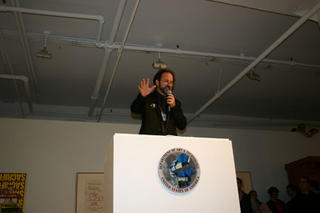 You can also add an image by uploading one from your hard drive. This image is from one of my performances at the White Box gallery in New York City. Notice that the text wraps around the image, I have indicated that the image be justified on the left. You can position images on the right, center or no wrapping at all.
You can also format your blog entries to include bold type, italics, you can have quotes:
"I Link, therefore I am." - Mark Amerika
 You can also add an image by uploading one from your hard drive. This image is from one of my performances at the White Box gallery in New York City. Notice that the text wraps around the image, I have indicated that the image be justified on the left. You can position images on the right, center or no wrapping at all.
Tuesday, August 31, 2004
What is Hypomnemata?
French theorist Michel Foucault refers to hypomnemata and the origins of the personal notebook as, "writing as a material support for memory." This is highly significant in our study of multimedia because the origins of information technology stem from the same desire, to extend human memory. We will see later in the course how Vannevar Bush, considered the father of the information age, outlined in his famous 1945 article, "As We May Think," the Memex (memory extension), a prototypical device that pioneered hypertext and on-line information storage and retrieval. This concept is a direct outcome of the notion of hyponmemata.
Foucault's comment, "these new instruments were immediately used for the constitution of a permanent relationship to oneself" is also relevant to contemporary thinking about the personal computer. The networked computer has redefined how we manage our affairs, conduct communication, document personal interests. The home page for example, has become a vehicle for self-publishing, self-expression, a record of preferences.
This concept of the hypomnemata thus becomes the starting point for using the new media to "collect the already-said," and "a means to establish as adequate and as perfect a relationship of oneself to oneself as possible." Too often the learning experience is a transient lesson in memorization. I would like us to use our web notebooks to "personalize" the content of this course, to internalize concepts, a laboratory of the mind.
Foucault's comment, "these new instruments were immediately used for the constitution of a permanent relationship to oneself" is also relevant to contemporary thinking about the personal computer. The networked computer has redefined how we manage our affairs, conduct communication, document personal interests. The home page for example, has become a vehicle for self-publishing, self-expression, a record of preferences.
This concept of the hypomnemata thus becomes the starting point for using the new media to "collect the already-said," and "a means to establish as adequate and as perfect a relationship of oneself to oneself as possible." Too often the learning experience is a transient lesson in memorization. I would like us to use our web notebooks to "personalize" the content of this course, to internalize concepts, a laboratory of the mind.
Subscribe to:
Posts (Atom)
