In order to embed a Google Map in your blog, you must do the following:
Go to Google Maps
Search for an address such as: 4400 Massachusetts Ave. Washington, DC
Select "satellite" map
Click on "Link to the Page"
Click on "Customize and preview embedded map"
Customize the size, preview, and
Copy and paste embed html field into your blog entry
Click on "View Larger Map" at bottom of entry to fully view the map
View Larger Map
Thursday, January 17, 2008
Tuesday, January 15, 2008
Thursday, September 06, 2007
Title of Post

This is a sunset over Death Valley
"Hottest, Driest, Lowest: A superlative desert of streaming sand dunes, snow-capped mountains, multicolored rock layers..."


Tuesday, March 27, 2007

You place your narrative in relationship to the image.
"If you have a quote that you want to offset."
I really miss my loft in San Francisco!
Wednesday, October 05, 2005
Embedding Links & Other Formatting
This post demonstrates that you can embed links into your blog in order to create what some would call a hyperessay.
You can also format your blog entries to include bold type, italics, you can have quotes:
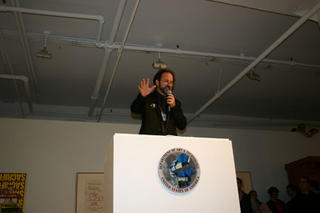 You can also add an image by uploading one from your hard drive. This image is from one of my performances at the White Box gallery in New York City. Notice that the text wraps around the image, I have indicated that the image be justified on the left. You can position images on the right, center or no wrapping at all.
You can also format your blog entries to include bold type, italics, you can have quotes:
"I Link, therefore I am." - Mark Amerika
 You can also add an image by uploading one from your hard drive. This image is from one of my performances at the White Box gallery in New York City. Notice that the text wraps around the image, I have indicated that the image be justified on the left. You can position images on the right, center or no wrapping at all.
Tuesday, August 31, 2004
What is Hypomnemata?
French theorist Michel Foucault refers to hypomnemata and the origins of the personal notebook as, "writing as a material support for memory." This is highly significant in our study of multimedia because the origins of information technology stem from the same desire, to extend human memory. We will see later in the course how Vannevar Bush, considered the father of the information age, outlined in his famous 1945 article, "As We May Think," the Memex (memory extension), a prototypical device that pioneered hypertext and on-line information storage and retrieval. This concept is a direct outcome of the notion of hyponmemata.
Foucault's comment, "these new instruments were immediately used for the constitution of a permanent relationship to oneself" is also relevant to contemporary thinking about the personal computer. The networked computer has redefined how we manage our affairs, conduct communication, document personal interests. The home page for example, has become a vehicle for self-publishing, self-expression, a record of preferences.
This concept of the hypomnemata thus becomes the starting point for using the new media to "collect the already-said," and "a means to establish as adequate and as perfect a relationship of oneself to oneself as possible." Too often the learning experience is a transient lesson in memorization. I would like us to use our web notebooks to "personalize" the content of this course, to internalize concepts, a laboratory of the mind.
Foucault's comment, "these new instruments were immediately used for the constitution of a permanent relationship to oneself" is also relevant to contemporary thinking about the personal computer. The networked computer has redefined how we manage our affairs, conduct communication, document personal interests. The home page for example, has become a vehicle for self-publishing, self-expression, a record of preferences.
This concept of the hypomnemata thus becomes the starting point for using the new media to "collect the already-said," and "a means to establish as adequate and as perfect a relationship of oneself to oneself as possible." Too often the learning experience is a transient lesson in memorization. I would like us to use our web notebooks to "personalize" the content of this course, to internalize concepts, a laboratory of the mind.
Subscribe to:
Comments (Atom)
